Uzbekistan: The Architectural Center of Central Asia
You travel through Kyrgyzstan and Kazakhstan and the landscape is the architecture. Mountains, steppe, sky. The built environment is functional. Yurts, Soviet concrete, modest mosques. Historic monumental architecture exists in places like Turkestan or Taraz, but it never developed into the large urban architectural tradition you see in Uzbekistan. Nobody goes to Almaty for the buildings.
Then you cross into Uzbekistan and something shifts completely.
Samarkand hits you like a different civilization. Which it basically is. The Registan, three madrassas facing each other across a square covered in tilework constructed between the 15th and 17th centuries, doesn't look like anything else in Central Asia. It doesn't look like anything else on earth, honestly. You stand in front of it and your brain keeps trying to find a reference point and failing.
That's not an accident. Uzbekistan developed an architectural tradition so distinct and so deliberately constructed that it became one of the most recognizable built environments in the Islamic world. Understanding how that happened explains a lot about why this one stretch of Central Asia looks so completely different from everything surrounding it.
The Rest of Central Asia Didn't Build Like This
This is the part worth sitting with for a second.
Kyrgyzstan's architectural heritage is nomadic. The yurt is the masterpiece. Portable, ingenious, perfectly adapted to a life spent moving between pastures. But permanent monumental architecture was never the primary focus because permanence wasn't the lifestyle. You didn't build massive stone mosques when you were moving your household twice a year.
Kazakhstan is similar. The steppe culture produced extraordinary craft traditions, metalwork, felt, jewelry, and some historic urban architecture in places like Turkestan, but the built environment never developed the monumental Islamic architecture you see in Uzbekistan. Astana's modern skyline is ambitious and strange but that's a 21st century project with oil money, not a historic tradition.
Turkmenistan and Tajikistan have important sites but nothing that created a coherent visual identity the way Uzbekistan did. Merv in Turkmenistan has significant ruins but they're ruins. The living tradition didn't survive the same way.
Uzbekistan is different because Uzbekistan sat at the center of everything.
The Blue Is Intentional
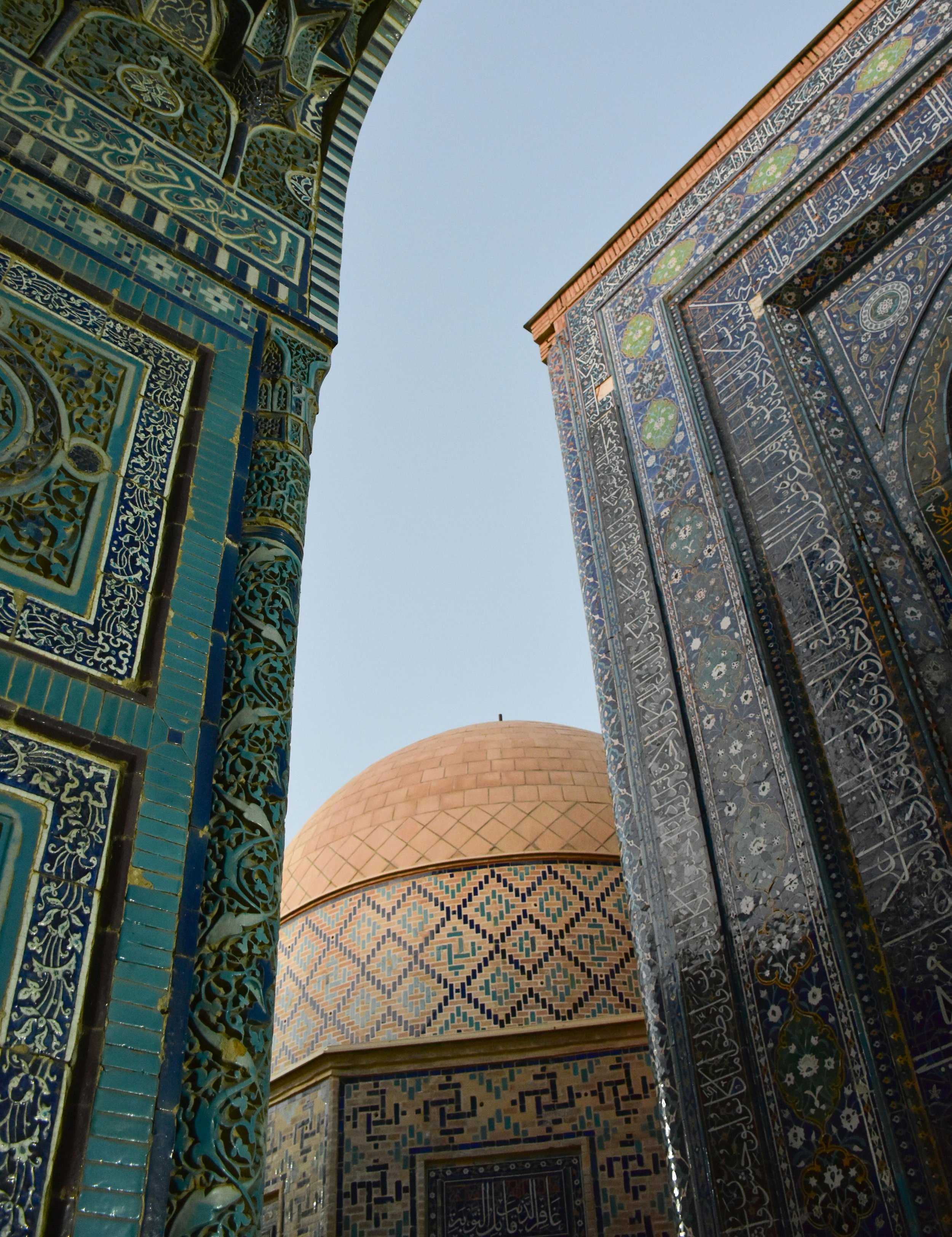
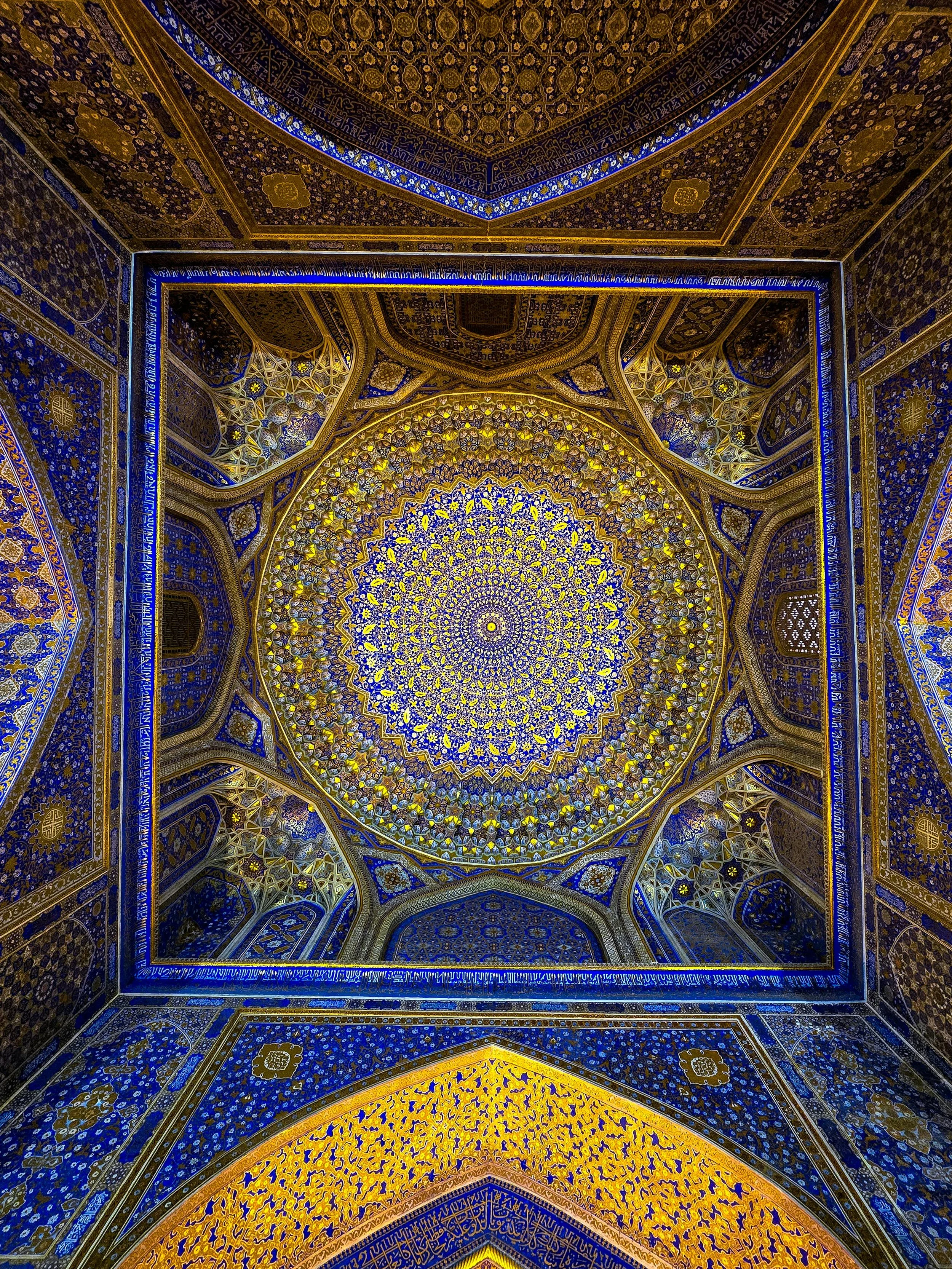
The blues that cover Timurid domes and facades aren't aesthetic preference in the casual modern sense. Turquoise and cobalt were widely used across Persian and Central Asian architecture and often carried associations with the sky or paradise in Islamic cultural traditions. Covering a dome in blue tilework visually connected the building to the sky above it and helped create the luminous effect that defines Timurid monuments.
This was theology expressed in ceramic.
The geometric patterns covering every surface came from a constraint that became a strength. Islamic artistic tradition in religious contexts often moved away from representational imagery of living things. That pushed craftsmen toward geometry, calligraphy and arabesque patterns as the primary vocabulary. Over centuries this produced a geometric tradition of extraordinary sophistication.
The patterns aren't just decoration sitting on top of the architecture. They are the architecture in a real sense. The same mathematical principles that make the geometric patterns visually coherent are the principles organizing the proportions of the buildings themselves. Surface and structure follow the same underlying logic.
Bukhara Accumulated What Samarkand Announced
Samarkand was built to impress. To be visible from a distance. To announce power immediately and overwhelmingly. The scale is imperial because that was the point.
Bukhara feels different and the difference is about time. Samarkand shows you one extraordinary period executed at maximum scale. Bukhara shows you what happens to a city that stays important across many centuries.
The Kalon minaret from the 12th century still stands. Genghis Khan destroyed most of Bukhara when he took it, and later historical accounts say he may have admired the minaret and left it standing, though this story is likely a legend. That minaret predates the Timurid period by centuries and looks completely different from Timurid work. Older, starker, the beauty coming entirely from brickwork pattern rather than tilework color.
The Samanid mausoleum from the 9th century is even older and even more different. Small, made of fired brick arranged in intricate surface patterns, no tilework, no massive scale. One of the oldest standing Islamic buildings in Central Asia. It looks like the ancestor of everything that came after it because it is.
Walking through Bukhara you're moving through architectural time. Different centuries in conversation with each other within the same city. That's something Samarkand, which was largely built or rebuilt within a relatively short Timurid period, doesn't offer.
There's a harder thing to say here too. A significant portion of what visitors see in Samarkand and, to a lesser extent, across Uzbekistan's historic cities is not original. Decades of Soviet-era intervention and accelerated post-independence restoration replaced deteriorated structures with new construction built to historical designs. Some travellers who know what they're looking at come away quietly deflated . The surfaces are too crisp, the symmetry too perfect, the patina absent in a way that only new tile can be. What was authentic aging got replaced with a replica of what the building was believed to have looked like. Bukhara's rougher edges, the unrestored sections, the places where centuries of actual use are still visible in the material, are partly what make it feel more real than the set-piece grandeur of the Registan. Whether that trade-off, accessibility, and visual impact over material authenticity was worth it is a question the Uzbek government made on behalf of every visitor. Most visitors don't know to ask it.
Karimov’s Tourism Vision
After independence in 1991, President Karimov made a deliberate calculation. While other Central Asian leaders were orienting their national identities around oil revenues or geographic pivoting toward Russia or China, Karimov presented Uzbekistan's future around something most of the region lacked: a built legacy that the world already recognized as extraordinary. The Silk Road, Tamerlane, the tilework of the Registan, these became instruments of state branding as much as historical facts. Tourism infrastructure was developed around Samarkand, Bukhara and Khiva with a directness and speed that reflected how seriously this vision was taken at the top. The result is visible today. Uzbekistan receives more international visitors than any other Central Asian country, and the architecture is the primary reason most of them come.
This Style Traveled
The Timurid architectural tradition didn't stay in Uzbekistan. It moved.
Babur, a descendant of Timur who lost Samarkand to the Uzbeks and eventually conquered India, brought elements of the Timurid and Persianate architectural tradition south with him. The Mughal architecture of India, the Red Fort, the Taj Mahal, draws from this broader Central Asian and Persian cultural heritage. The turquoise tilework became white marble inlay. The geometric patterns became pietra dura, stone inlay in floral and geometric designs. The underlying architectural vocabulary reflects ideas that circulated widely across the Persianate world, including those developed in Samarkand and Bukhara.
Persian Safavid architecture in Isfahan shows the same influence through different channels. The great mosques of Iran and the buildings of Uzbekistan are clearly in conversation with each other, sharing geometric principles, color vocabulary and spatial ideas that both inherited from the same synthesis happening in Central Asian cities.
Uzbekistan didn't just build impressive buildings. It created a visual language that spread across a significant portion of the Islamic world and still defines how people recognize Islamic architecture in its most elaborate forms.