Symbolism in Central Asian Felt Making
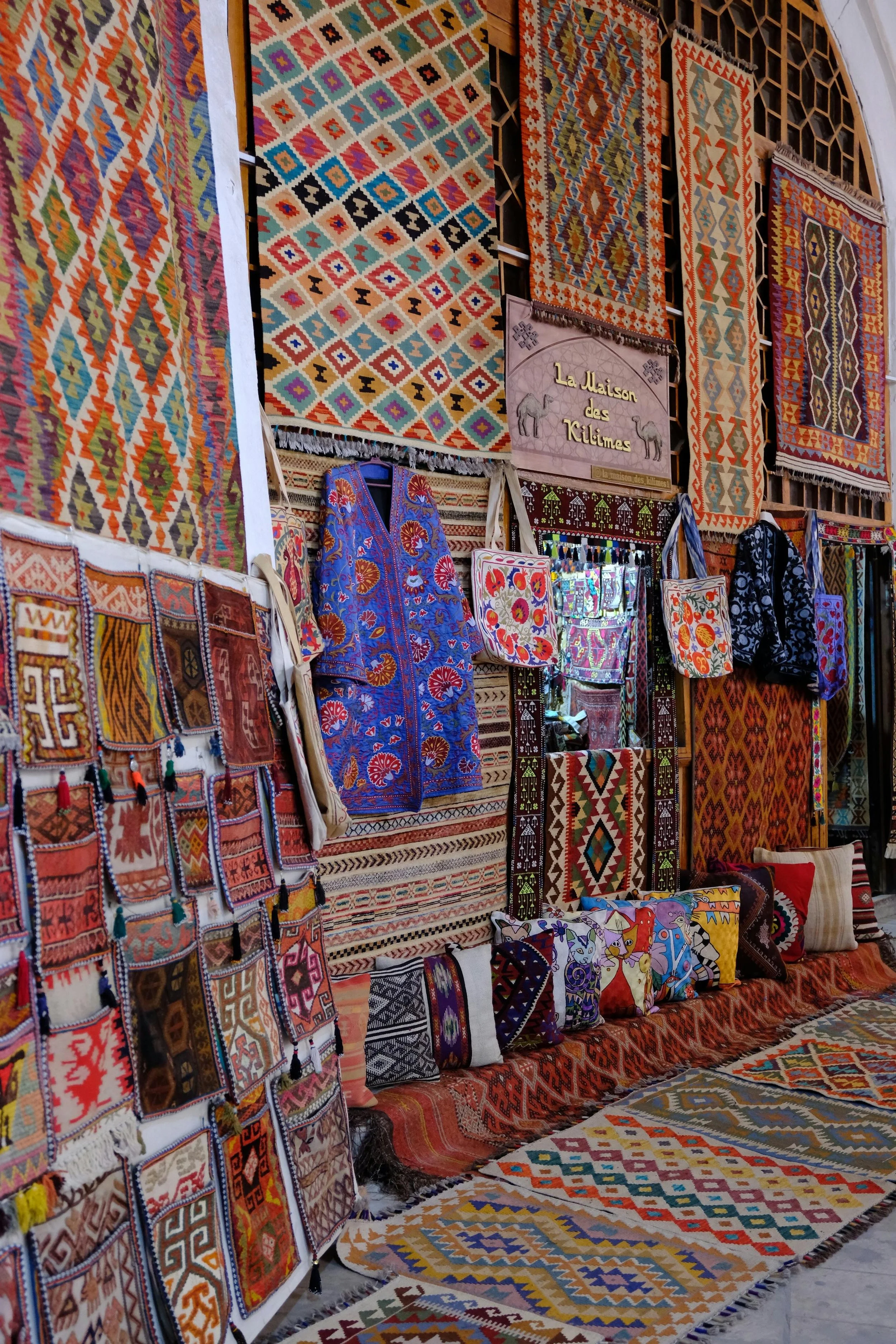
You walk into a yurt somewhere in Kyrgyzstan and the walls are covered in thick felt rugs. Red and white. Sometimes blue. Shapes that curl and repeat and mirror each other. You think, that's beautiful, take a photo, and move on.
That's what everyone does. Including me, the first time.
Here's what nobody mentions. Those patterns aren't decoration. They're not just Central Asian aesthetics or traditional design in the vague tourist brochure sense. Each shape has a name. Most have a meaning. Some were put there for a specific reason that has nothing to do with how the room looks.
Once you know that, you can't walk into a yurt the same way again.
Two Different Things That Get Lumped Together
Shyrdak and ala-kiyiz. People use these words interchangeably and they're not the same thing at all.
Shyrdak is the one with the clean, sharp shapes. Two layers of colored felt stacked and cut at the same time. The cut pieces get swapped between layers and sewn back in. Red shapes on white on one rug, white shapes on red on the other. Every shyrdak produces a pair. The cutting happens freehand, no template, the design lives entirely in the maker's hands. Older women in rural Kyrgyzstan still do this. Watch one work and you'll understand immediately why this skill takes years.
Ala-kiyiz is older in technique. Raw wool laid out in colored sections, wetted, rolled, pressed until everything locks together into one piece. Softer edges. Almost looks painted. Completely different feel from shyrdak even though both come from the same nomadic tradition and the same mountain culture.
Both kept yurts insulated through winters that would kill you if you were unprepared. Function first. Everything else second.
The Horn Is Everywhere
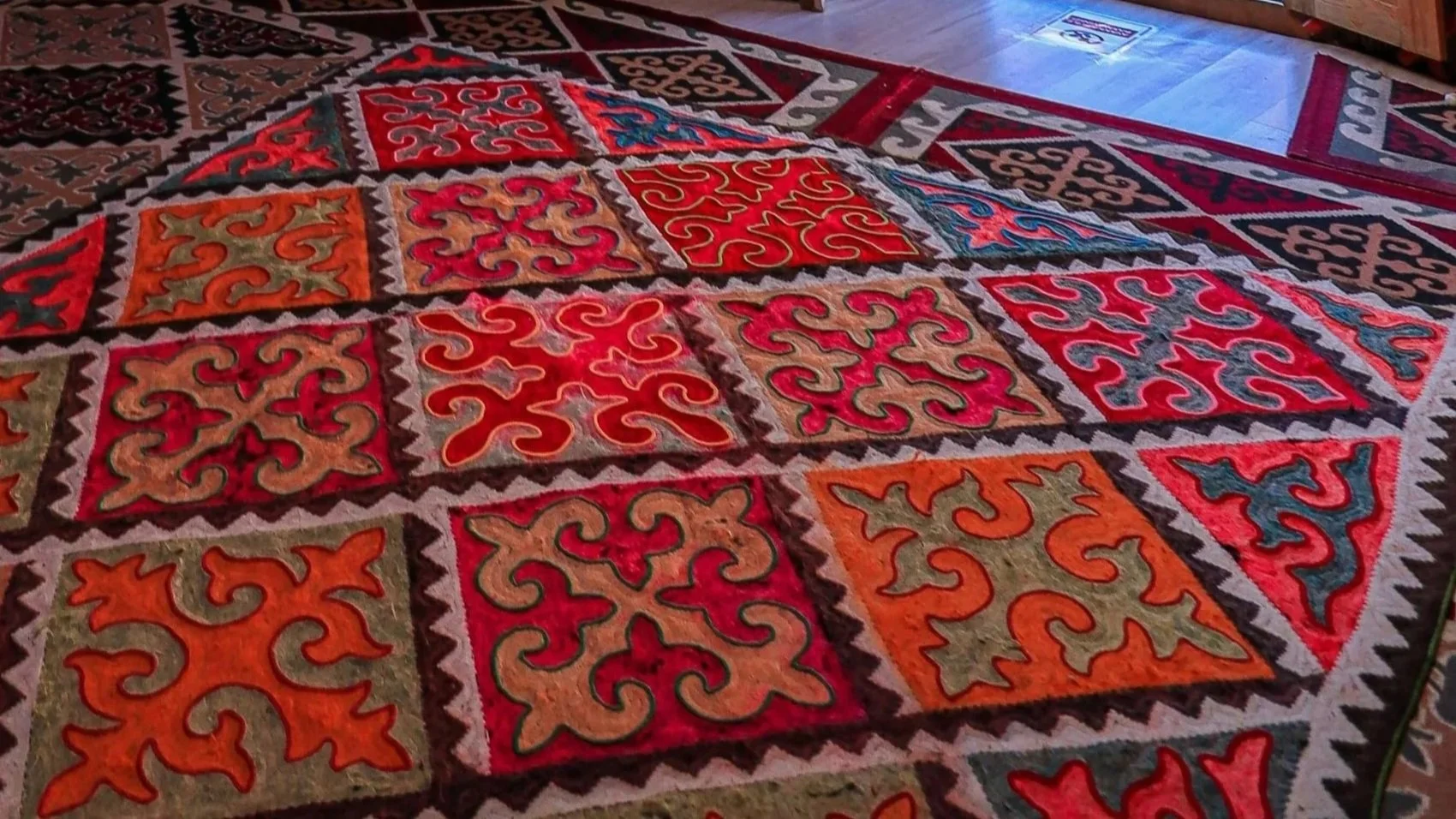
Kochkor Muuz. Ram's horn. Spiral shape, recurved, often doubling back on itself. It shows up on borders, in center fields, in corners. Sometimes bold and obvious. Sometimes reduced down so small you almost miss it repeating across the whole edge of a rug.
Why a ram specifically. Because for nomadic people the ram was essentially the economy. Wool, meat, milk, leather. You sacrificed rams when guests arrived who deserved honoring. At weddings. At funerals. The horn carried associations with protection and household strength that went beyond the animal itself. The spiral connected to continuity: something that keeps going rather than ending.
Putting Kochkor Muuz on a rug wasn't a design choice the way we'd think about it now. It was closer to a statement. This household has what it needs. This household is protected.
Kazakh textile traditions use horn motifs too. The Kazakh versions tend toward harder angles. Kyrgyz ones are rounder, more fluid. Same idea, different hand.
A Frog Pattern in the Mountains
Baka. The frog. Less common than the horn but worth knowing about because of what it tells you.
Frogs meant rain. Rain meant grass. Grass meant the herds survived the season. On the steppe and in mountain pastures where the entire economy ran on animals that needed water, frogs appearing in spring actually mattered to people. The baka motif is that relationship written in felt. Small detail. Big context behind it.
Other animal motifs carried similar weight. The dog's tail, It Kuyruk, runs along borders as a curving s-shape, standing for loyalty and the protection dogs give to the herd and the household. The bird, Kuş, appears in some regional traditions as a symbol of freedom and the soul's movement. Each animal that mattered in daily life eventually found its way onto felt.
The Pomegranate and The Tree
Uzbek felt traditions work with a different visual vocabulary, one shaped more by Persian cultural currents than by the steppe.
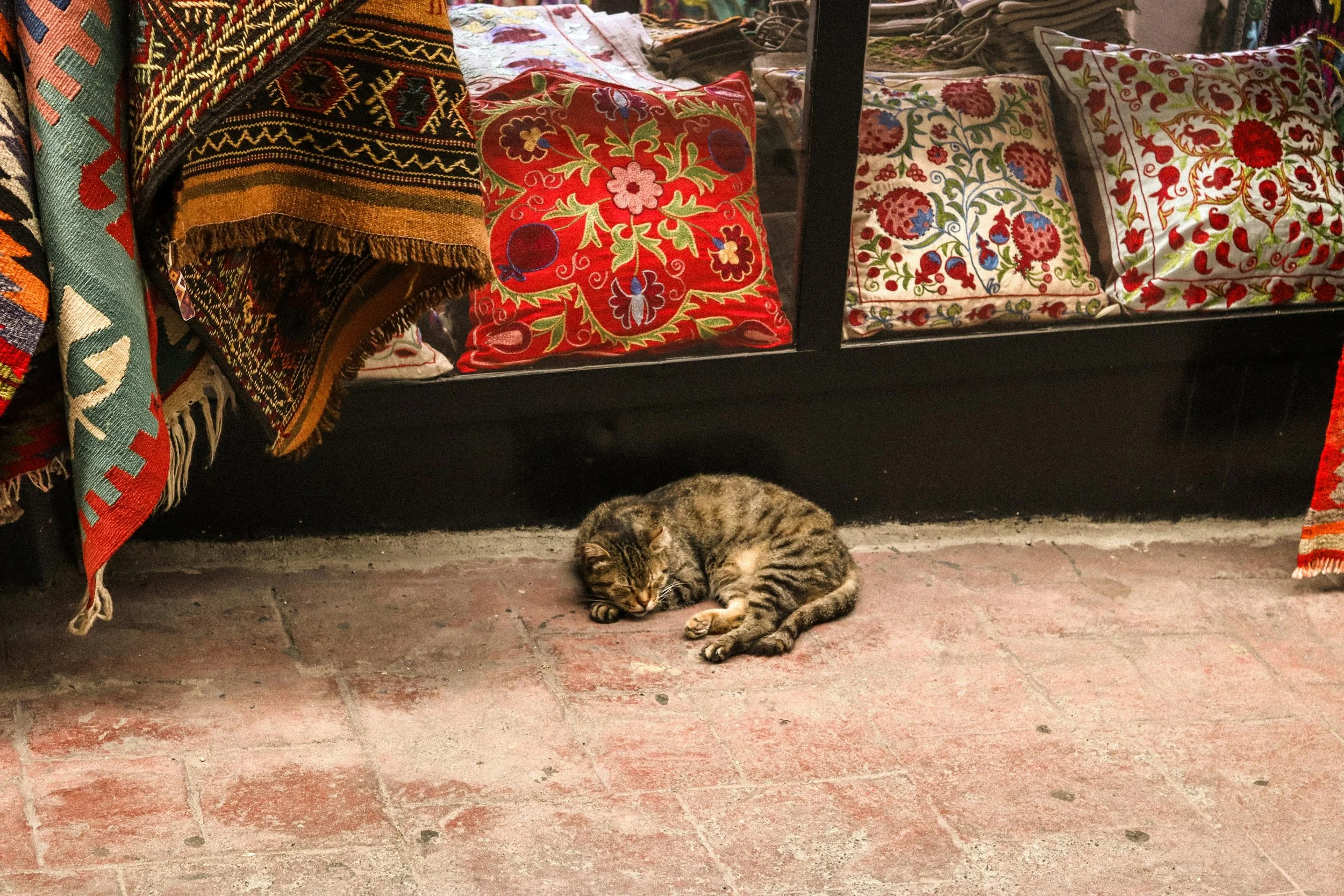
The pomegranate, Anor, appears constantly across Uzbek craft in every medium. Tiles, embroidered suzani, felt. It stands for fertility and abundance. Split open, the seeds suggest new life multiplying outward. The association traveled into the region with Persian influence centuries ago and never left.
The tree of life appears too. Often so stylized that you need someone to point it out before you see it. Vertical axis, branching form. Connection between what's below and what's above: ancestors and descendants, earth and sky. The Uzbek version is one of dozens of visual languages across human history that reached for the same idea.
The Borders Are Doing The Real Work
The border of a shyrdak isn't just a frame around the main design. In traditional use, borders were protective. Meant to define an edge that certain things couldn't cross. The yurt was where births happened, where people died, where marriages got formalized. Not just a house. The textiles inside it were part of maintaining that space as something distinct from the world outside.
Certain border patterns were used in specific contexts. Wedding rugs differed from everyday rugs. Rugs near the entrance sometimes carried different designs than ones on the back wall. Some of this is documented now. A lot of it isn't, held in fragments by women in their seventies and eighties who learned it before anyone thought to write it down.
That knowledge is genuinely disappearing. Not slowly either.
The Colors Aren't Random Either
Red dominates traditional Kyrgyz shyrdak. Not because red looks good, though it does. Red carried protective associations. Linked to vitality and life in a way that was understood, not just felt aesthetically.
Undyed white wool in patterns was sometimes considered different in quality from dyed felt. Purer, closer to its original state. Not a strict rule. More like an inherited logic that ran underneath the craft, the default grammar that makers worked within and deviated from deliberately rather than casually.
Dark tones, navy and black, provided contrast in compositions but also carried weight. Night sky. Permanence. Depth. Color choices in traditional textile work connected to meaning rather than existing separately from it. That's almost impossible to fully access now through looking alone. But knowing it was there changes how you look.
Nothing Here Has Just One Meaning
This is the part that gets complicated.
Most of these symbols are not from one era or one cultural framework. They predate Islam in the region by a long stretch. Shamanistic associations, protection ideas, cosmological thinking from a time when the sky and certain animals were understood as active forces that affected your life. Not abstract belief. Practical reality for people living exposed to weather and distance and predators.
Then Islam spread across Central Asia and didn't erase those symbols. It reframed some of them. Endless knot patterns, which appear in felt borders and embroidery and carved woodwork everywhere across the region, carry ideas about eternity that fit into Islamic cosmology well enough that the pattern not only survived but got more elaborate. Pre-Islamic origin. Islamic meaning sitting on top.
Then Soviet cultural policy happened. Craft cooperatives produced shyrdak as folk art. That category stripped the spiritual content out and presented pattern as pure decoration. Safer that way. Symbols with shamanistic associations weren't going to be officially celebrated anywhere in Soviet Central Asia. The patterns kept getting made. The meanings got quieter.
Then independence. And a real effort, still ongoing, to recover what got flattened. Finding the older craftswomen who still remembered what patterns were called and what those names meant and when certain designs were used for what purpose.
So when you're looking at a shyrdak you're sometimes looking at something with four different cultural frames stacked on top of each other. Same shape. Different meaning depending on who's reading it and from where. That's not a problem with the symbols. That's just what happens to things that survive long enough.
What's Actually at Stake
The women who hold the deepest knowledge about what these patterns mean and when they should be used are mostly old. Urbanization pulled younger generations toward Bishkek and Almaty and Tashkent. The knowledge that survived Soviet rule survived partly because grandmothers taught daughters in kitchens and workrooms, not in official settings where it would have been flattened into folk art anyway.
Documentation is happening. NGOs working with rural craftswomen, researchers recording oral knowledge, younger designers trying to use these symbols in ways that don't just treat them as attractive shapes for export products. The effort is real.
But there's a difference between documenting something and keeping it alive as a practice. You can write down what kochkor muynuz means. That doesn't mean the next generation of feltmakers feels that meaning when they cut the shape. The living transmission is the hard part. And that's what's actually fragile right now.
Slow Down When You're in the Room
If you're in a yurt or a craft market or a museum with felt work on the walls, stay longer than your first instinct tells you to. Find the horn motif. Look at what the border is doing. Notice where the colors reverse and what that reversal does to the overall composition. If you're somewhere with a maker present, ask what a specific pattern is called.
You're not looking at decoration. You're looking at a writing system that nomadic people built to say things about protection and wealth and continuity and their relationship with the animals and landscape they depended on. It survived conquest and religious change and Soviet erasure and it's still there on the wall.
Most people walk past it. You don't have to.